Translate
Monday, August 3, 2020
Friday, July 24, 2020
Friday, January 17, 2020
The Grass Is Blue, Anne Wright Wilson Gallery, Georgetown College, Kentucky
The Grass Is
Blue highlights
multiple Kentucky histories. The work is a response to stories
evolving around the enslaved and native peoples, as well as from the specific
geography and commerce surrounding them. These topics generate a discourse
rooted in diversity and place. My intent is to raise awareness of past
events, to reflect upon the span of humanity and culture within the region, and
to generate current feelings of empathy and community. Consequently, I
utilize various materials and processes to create an inclusive visual language
that acknowledges the people, events, and land in which they have
emerged. -November 2019
Find Your Purpose
Silk dyed with marigolds, fan, magnets.
Title from Frank X. Walker poem “Murphy’s Secret”.
46” Length x 13” Width x 7” Tall
Kentucky History: Isaac Murphy wins the silk
purse.
Corner Installation #2
Breathing Shared Dreams
Mirrors, wood, paint, text.
Words from bell hooks poem #37
Kentucky History: Slavery
Wednesday, July 31, 2019
Collaborative Kentucky Drawing Project
The project highlights contributions made by three women made to science within the state of Kentucky. I am collaborating with Kentucky artists to produce a drawing collection that represents specimens associated with Wharton, Price and Braun. The drawing collection will be on view November 2019 at the Anne Wright Wilson Gallery, Georgetown College, Kentucky.
Mary E. Wharton
Over 400 specimens for Wharton in the New York Botanical Garden database.
Two links, each provides a different search format.
Images of specimens and illustrations from the Missouri Botanical Garden.
Link below to Plant Illustrations by Sarah Sadie Francis Price.
https://mobotgarden.photoshelter.com/galleries/C0000p4RJPe_kf2I/G0000C1Tk99ToqvM/Plant-Illustrations
Link below to Herbarium Specimens associated with Sarah Sadie Frances Price.
https://mobotgarden.photoshelter.com/galleries/C0000p4RJPe_kf2I/G0000jlsPFf7mmpU/Herbarium-Specimens
E. Lucy Braun
200 specimens for Braun can be found at the New York Botanical Gardens.
Two links, each provides a different search format.
If interested in participating, please contact lmongiovi@flagler.edu
Participants from all over Kentucky produced drawings in response to the specimens
of Wharton, Price and Braun.
208 Drawings, Black and White Media on Paper
On exhibit at Georgetown College
Labels:
Braun,
Drawing Collaboration,
Georgetown College,
Kentucky Botany,
Price,
Wharton
Monday, April 8, 2019
Italian Velvet History: Textile Images
The most fanciful images of the weaver's art across the centuries: upon thrones, altars, in royal bed chambers, bourgeois drawing rooms and the ateliers of great couturiers; it is velvet which has marked entire eras. Guiseppe Verdi demanded only the finest velvets for the outfits for the characters in his operas, and the same was true for Rossini and Donzietti. From Caruso to Galeffi to Giuditta Pasta, one and all lavished maniacal attention to the velvety spectacle of the costumes of their operas. And what shall we say then for the long list designers, from Courreges, Cardin, Rabanne, Marucelli, and De Barentzen?
Velvet, however, has been first and foremost an economic phenomenon, which has generated enormous wealth, enough to pay armies, create banks, and radically shift the array of international economies. A powerful lever in the great trade of the Renaissance, velvet made the fortunes of the bankers and merchants of city-states such as Lucca, Florence, and the maritime republics of Genoa and Venice. For centuries, these cities dominated the textile markets of the entire world, with their velvets influencing the prices of raw materials, commercial treaties, fashions, technology, and new discoveries.
The earliest traces of velvet were lost somewhere on the legendary Silk Road, the great transcontinental caravan route that connected Lo-Yang with the Ch'ang-an through the Taklimakan, the desert without return, all the way to the port cities of the eastern Mediterranean. As to the origins of velvet, scholars from all over the world have discussed and debated for many years. It is now a general belief this fabric, originally made of silk, arrived in Italy for the first time from the Far East, transported by Arab merchants, and was then spread throughout Europe, in turn, by the merchants from Lucca, Venice, Florence, and Genoa.
In Italy, beginning in the twelfth century and continuing through the entire eighteenth century, the largest industry for the production of velvets in the western world was set up. For centuries in Lucca, Siena, Venice, Florence and Genoa supplied the rest of Europe with these valued fabrics, to be used in clothing, wall coverings, upholstery, the trapping of horses, furniture of all sorts, and the interiors of carriages and litters.
Many historians claim that the earliest velvets were woven in Palermo, in imitation of the velvets in the east. The hypothesis that this precious cloth was first woven in Sicily and later spread to the rest of Italy was first put forth by the French Scholar A. Latour. Many other scholars tend to favor the Venetian route, since there is documentation from as early as the ninth to eleventh centuries of intense trade between Venice and the East. However, Arabic is the only language that makes use of the name of a city Kathifet in mentioning velvet. This city may well be the place where this type of cloth was produced for the first time. But on the other hand, in Italy, the fabric takes the name from the characteristic appearance - in Italian, "vello" means fleece, and "velluto", or velvet, means fleecy.
source http://www.textileasart.com/weaving.htm
Velvet, however, has been first and foremost an economic phenomenon, which has generated enormous wealth, enough to pay armies, create banks, and radically shift the array of international economies. A powerful lever in the great trade of the Renaissance, velvet made the fortunes of the bankers and merchants of city-states such as Lucca, Florence, and the maritime republics of Genoa and Venice. For centuries, these cities dominated the textile markets of the entire world, with their velvets influencing the prices of raw materials, commercial treaties, fashions, technology, and new discoveries.
The earliest traces of velvet were lost somewhere on the legendary Silk Road, the great transcontinental caravan route that connected Lo-Yang with the Ch'ang-an through the Taklimakan, the desert without return, all the way to the port cities of the eastern Mediterranean. As to the origins of velvet, scholars from all over the world have discussed and debated for many years. It is now a general belief this fabric, originally made of silk, arrived in Italy for the first time from the Far East, transported by Arab merchants, and was then spread throughout Europe, in turn, by the merchants from Lucca, Venice, Florence, and Genoa.
In Italy, beginning in the twelfth century and continuing through the entire eighteenth century, the largest industry for the production of velvets in the western world was set up. For centuries in Lucca, Siena, Venice, Florence and Genoa supplied the rest of Europe with these valued fabrics, to be used in clothing, wall coverings, upholstery, the trapping of horses, furniture of all sorts, and the interiors of carriages and litters.
Many historians claim that the earliest velvets were woven in Palermo, in imitation of the velvets in the east. The hypothesis that this precious cloth was first woven in Sicily and later spread to the rest of Italy was first put forth by the French Scholar A. Latour. Many other scholars tend to favor the Venetian route, since there is documentation from as early as the ninth to eleventh centuries of intense trade between Venice and the East. However, Arabic is the only language that makes use of the name of a city Kathifet in mentioning velvet. This city may well be the place where this type of cloth was produced for the first time. But on the other hand, in Italy, the fabric takes the name from the characteristic appearance - in Italian, "vello" means fleece, and "velluto", or velvet, means fleecy.
source http://www.textileasart.com/weaving.htm
Sunday, March 17, 2019
Shawnadithit: Last of the Beothuk
All three women were sick with the consumption that was a plague among the Beothuk. Shawnadithit's sister died and soon it was obvious that her mother was dying too. Shawnadithit took her mother to a sandy point by the waters of Red Indian Lake, held her in her arms and sang her people's last lament. She sewed her body into a blanket of birch bark, buried her and set out alone for the coast, stumbling out at Notre Dame Bay. She knew now that she was the last of her people.
The Beothuk were a semi-nomadic people who wintered around the shores of the beautiful lakes of the interior of Newfoundland, where they hunted caribou and other game. In the spring they would paddle off downriver to the coast to hunt seal and salmon, fashioning most of what they needed along the way. They built unique conical birch houses called mamateeks which featured double layers of birch and moss insulation.
Excerpts from:
| Article by | James H. Marsh |
| Published Online | June 17, 2013 |
| Last Edited | March 4, 2015 Source link: https://www.thecanadianencyclopedia.ca/en/article/shawnadithit-last-of-the-beothuk-feature |
Labels:
Birdhouse,
Death,
Female Mapmakers,
Sewing,
Shawnadithit
Embroidered Silk Globe
The turn of the 19th century was a time of tremendous change on the North American continent, as new nations established their laws and societies. Among many other transitions, education was changing for young women. In the nascent United States, secondary schooling for girls proliferated for the first time. Academies taught the old domestic skills, such as sewing, music, and fine etiquette, but they also taught “solid subjects,” such as mathematics, history, and geography. In this moment came an object that blended these shifting educational domains: the embroidered silk globe.
http://samplings.com/curator-archives/stitches-unraveling-their-stories
Sunday, February 24, 2019
February 21 - 23, 2019
Flagler College Campus, St. Augustine, Florida
Symposium organized and led by
Elizabeth Kozlowski, Editor Surface Design Journal and Curator, New Orleans
Laura Mongiovi, Associate Professor, Art and Design, Flagler College
Flagler College Campus, St. Augustine, Florida
Symposium organized and led by
Elizabeth Kozlowski, Editor Surface Design Journal and Curator, New Orleans
Laura Mongiovi, Associate Professor, Art and Design, Flagler College
The documentary Blue Alchemy: Stories of Indigo
by Mary Lance was part of the programming for the symposium.
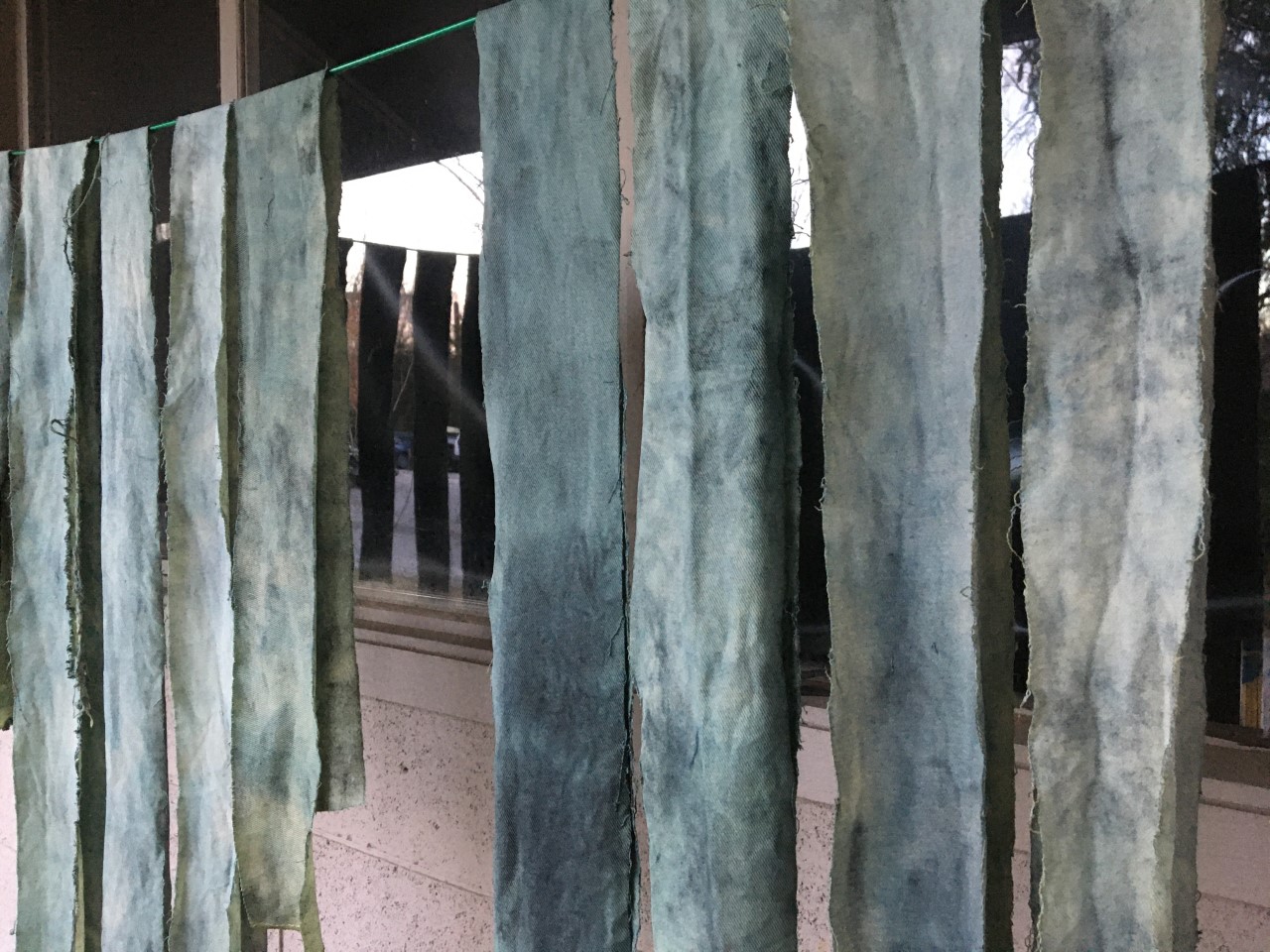
The title BLUE ALCHEMY refers to the magical process by which indigo-dyed textiles, which look dull green in a vat, emerge into the air and are transformed to a vivid blue. Making the dyestuff itself involves transformation. Green plants are soaked and fermented. The liquid is beaten into a foam and drained, producing the indigo dyestuff. Indigo’s place in the world has also undergone a transformation. From its historical association with slavery it has emerged as the means by which people are improving society or maintaining their cultural traditions in a changing world.
Artists:
Mary Lou Alexander
Samantha Connors
Paula Damm
Rachel DeCuba
Nick DeFord
Amelia Eldridge
Susan Finer
Amy Freeman
Grace Jinnah
Lyn Linnemeier
Tony Williams
Terri Witek
Color: A Natural History of the Palette
I first posted this book back in 2010.
Re-posting as I have been talking about the book lately during my artist talks.
Link to author's website below:
https://victoriafinlay.com/
Labels:
Authors,
books,
Color History,
dye,
Dye History
Friday, February 22, 2019
The Jacket from Dachau: Maps and Infographics
All graphics were originally produced by the curatorial team; they contain images and research (with permissions granted) from USHMM, Yad Veshem, Jewish Virtual Library, The Simon Wiesenthal Center, the Anti-Defamation League, and the Encyclopedia of the Holocaust (1990; I. Gutman, ed.). Information and data in the infographics were fact-checked by Dr. Geoffrey Megargee of the USHMM. For more information,
contact Dr. Cary Lane.
The Jacket from Dachau: One Survivor’s Search for Justice, Identity, and Home
Survivors of the Holocaust frequently attribute their ability to avoid death to one main variable: luck. For Benzion Peresecki, the 15 year-old son of a delicatessen owner from Radviliškis, Lithuania, surviving the Holocaust was indeed fortunate, but came at an immense cost.
Within a span of 10 years, Benzion’s father died from a stomach ulcer, his brother was murdered by the Nazis, he was forced into a ghetto, and was imprisoned, beaten, and subjected to forced labor at the Dachau concentration camp. After liberation, Benzion spent five years in a displaced persons camp with his mother, Chiena, who herself survived a death march at the Stutthof concentration camp.
After immigrating to the United States, Benzion fought to re-establish his identity, find justice for his family’s suffering, and create a new home. Throughout his postwar years, no matter where he lived and how many times he moved, he always kept his jacket from Dachau.
Benzion never explained to his family or friends why he brought the jacket with him to New York; in fact, he never told his children that it even existed. However, keeping his jacket is consistent with other resilient actions on his part: his immigration to the United States; his search for a new, meaningful identity despite underemployment and several iterations of his name (he formally changed his name to “Ben Peres” soon after his immigration); his courage coping with the emotional and psychological stress from his traumas; his tenacious search for justice through a decades-long reparations campaign with the German government; and, his determination to support his wife, mother, and two children in New York.
On July 4, 2015, Ben’s jacket, which had been in his closet for 65 years (and 37 years after his death), was discovered at the estate sale of his home in Bellmore, Long Island by a vintage clothing collector named Jillian Eisman. Ms. Eisman’s grandfather served in the Soviet army during World War II, and her brother was killed on 9/11; so, she immediately recognized the jacket as an object of pain, understanding, comfort, and reflection with which the public should engage. She subsequently donated the jacket to the Kupferberg Holocaust Center to ensure that students and the broader community could view the jacket and understand its significance.
New York, a city of immigration, determination, tragedy, and perseverance, also plays a role in this story. Ben and his mother lived and worked in Brooklyn, the Bronx, and Manhattan after their immigration. They also both received medical treatment from several New York doctors for physical and psychological injuries sustained during the Holocaust. In 1968, with modest reparations payments awarded by the German government more than 20 years after their liberation, Ben and his mother, Chiena, along with his wife, Chaya, and two children, Lorrie and Michael, were finally able to buy a permanent home in Bellmore, NY. Ben lived there until his death in 1978.
This exhibit was compiled from over 1500 documents, films, and photographs left by Ben Peres and his family that contextualize his search for justice, identity, and home after he was torn away from his Lithuanian home. The curatorial team for the exhibit included Queensborough’s own students and KHRCA interns: Peter Bandziukas, Kaitlyn Cicciariello, Gillian Farnan, Abigail Jalle, Alejandro Leal-Pulido, Daniel Nussdorf, and Nitya Ramanathan.
We encourage you to visit the reflection area in the gallery and in the online version of the exhibit, both of which are structured to document your own responses to this compelling story.
―Cary Lane, Ph.D., Curator-in-Residence, KHRCA, Assistant Professor of English
―Dan Leshem, Ph.D., Director, KHRCA
We would like to acknowledge and thank Marisa Hollywood, Assistant Director of the KHRCA, Yad Vashem, the United States Holocaust Memorial Museum, Dr. Geoffrey Megargee, Dr. Saulius Sužiedėlis, Jillian Eisman, Sam Widowsky, the USC Shoah Foundation, Kat Griefen, Lorrie Peres, and Michael Peres for testimonies, historical information, fact-checking, documents, images, and films that helped contextualize the artifacts in this exhibit. We also wish to thank Henry Schein, Inc. and Henry Schein Cares for their invaluable mentorship and support.
Source:
Queensborough Community College
Labels:
Holocaust,
Textile Exhibitions,
Textile History,
Uniforms
Subscribe to:
Posts (Atom)